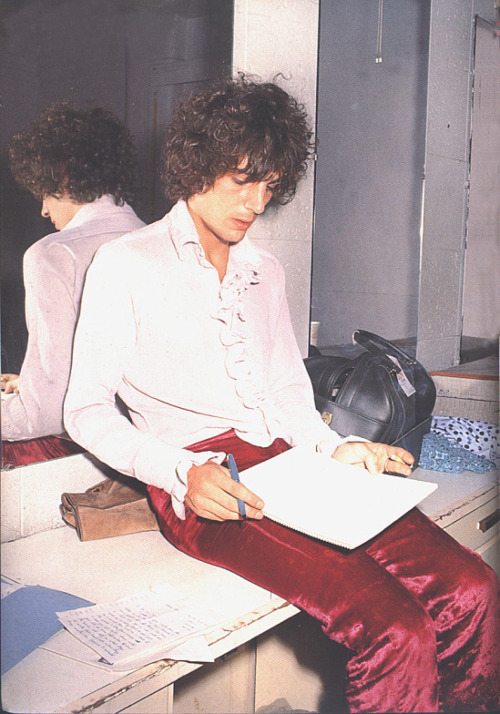
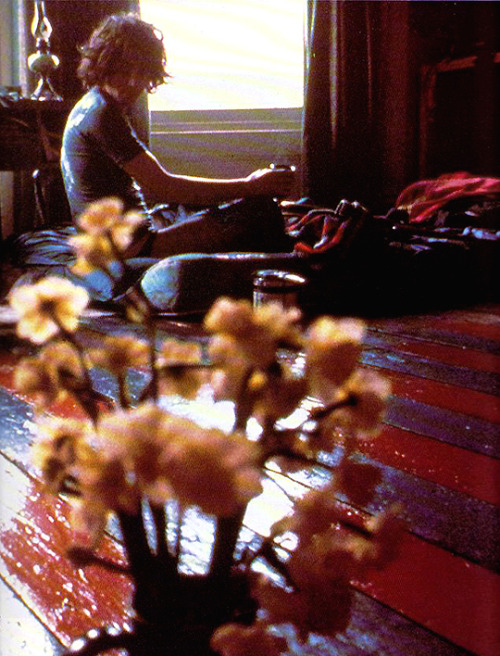
Stash Klossowski De Rola , 1965
The name Stash Klossowski De Rola often gets a mention in various Rolling Stones biographies - a mysterious young aristocrat who got busted with Brian Jones in 1967. Apart from the fact that he was a close friend of Brian's , little was known about Stash. It is a shame, because he certainly was a fascinating figure - In the 1960's, he starred in Luchino Visconti's film, he was a drummer for Vince Taylor, he was a pop singer (he released a single as Stach De Rola in 1967) and was involved in various Hollywood productions - and that's just for starters. He was friends with Stones, Beatles, Syd Barrett, Paul Simon and many other legendary musicians. The list of his lovers (although, in truly gentlemanly manner, he seems rather reluctant to talk about it) includes Marianne Faithfull, Anita Pallenberg and Nico. He was, and still is, a man of wealth and taste - and what's important for readers of this blog, his impeccable dress sense makes him one of the icons of Peacock Style.

Stash (in the middle) with Sir David Napley, QC (left) and chauffeur and roadie of The Rolling Stones Tom Keylock (right). June 2nd 1967.
In 2011, Stash was tracked down by Peter Markham, who subsequently interviewed him for
Ugly Things - a magazine devoted to 1960's music. In this very extensive interview (parts of which are quoted here), Stash talks about his life in 1960's.
Stash' full name is Prince Stanislaus Klossowski De Rola, Baron De Watteville. He is a son of one of the greatest painters of twentieth century - Balthus (A Polish-French aristocrat whose full name was Count Balthasar Klossowski De Rola). His mother was a Swiss aristocrat named Antoinette Von Wattenwyl (Or De Watteville). Stanislaus (Stash to his friends) was born on 13th of October 1942 in Bern, Switzerland. He spent his childhood in Villa Diodati in Cologny above Geneva - a mansion that was once a residence of distant ancestor of Stash's - Lord Byron (Percy and Mary Shelley had visited Byron in Villa Diodati in 1816. A night spent there is said to have inspired Mary Shelley's Frankenstein. For those who are interested in subject, I recommend a brilliant film by Ken Russell titled Gothic from 1986, shot on the original location in Villa Diodati).
During his adolescence, spent in Swiss and English boarding schools, Stash started developing keen interest in acting as well as rock'n'roll music. When I was 14 I became an ardent fan of rock'n'roll, collecting Elvis records and riding my horse, sometimes through the snow, to visit the only house with a TV in entire region in order to view the rock'n'roll show 'Six Five Special'. I was then discovered by director Luchino Visconti in Rome in 1959 and signed to a film contract. I attended the 13th Cannes Film Festival with Fellini in 1960. I lived between Rome, Paris and London and was friends with a lot of African-American musicians including the late Tony Williams, lead singer of The Platters. In the late 1962, I went to New York to pursue my acting career and thence to Hollywood (Ugly Things magazine, issue 31, 2011, p 78).
Stash circa 1963
In late 1964, Stash returned to Paris, where he joined The Playboys - a backing band of his old friend Vince Taylor, as a percussionist. When in 1965, Vince Taylor co-topped the bill with The Rolling Stones at Paris Olympia, Stash befriended Brian Jones. Initially, I was only really close to Brian , although I was also very friendly with everyone else in the band. My own friendship with both Mick and Keith really only fully blossomed in the wake of the tragico-farcical bust, with Brian, that ruined many things in my professional life, but earned me the sympathy and enduring friendship of The Beatles that led me to play with them (Ugly Things, p 78).
Vince Taylor and The Playboys in Paris, 1965. From left: Alan Bugby, Vince Taylor, Stash Klossowski de Rola and Bobbie Clarke.
Following Vince Taylor's drug and alcohol-induced nervous breakdown in spring 1965, Stash started a new band with drummer Robbie Clark and guitarist Ralph Danks. Following a series of gigs at Paris club Bilboquet as well as the gig at the happening at American Center (organized by Arrabal, Roland Topor, Alejandro Jodorowski and Stash himself) the band was offered recording contract by Paris label which wanted to promote them as 'French Beatles'. However their dislike of the contemporary French pop was a main reason behind their decision to turn down the offer. Instead, Stash , Robbie and Ralph chose to follow the Everly Brothers (whom they met one night at Bilboquet) to Los Angeles. Stash reminisces of the mid-sixties LA music scene: On the whole the musical scene was incredibly rich and we were all friends. Arthur Lee and Bryan McLean were my closest friends from Love, but I was also close to Chamber Brothers, To Roger (then Jim) McGuinn and many others besides our beloved Everly Brothers. We attended a showcase concert of The Yardbirds at the private home in the Hollywood Hills, a memorable concert of James Brown, were guests on a TV show with Sonny and Cher, and also attended Bob Dylan's Hollywood Bowl concert (Ugly Things, p 80). However, being a long haired hippie in the mid-sixties America, had its dark side: The climate of those golden days that mesmerize some of the youth of today do not take into account the climate of hatred, the 'fear and loathing' that we inspired in the hearts of straight society. It is well worthy of note to recall that somehow one's long hair and strange clothes were perceived as such a threat, that they warranted unprovoked violence. All modern freaks owe us a large debt of gratitude as we weathered the jibes, were persecuted by the authorities, and as often as not had to fight against all manner of louts offended by one's appearance (Ugly Things, p 80).

Stash Klossowski De Rola (left) and Ralph Danks photographed for a fashion magazine in Los Angeles in 1965.
Another memorable episode from Stash's stay in Los Angeles was a meeting with director Bob Rafaelson and producer Bert Schneider: Bob Rafaelson and his partner were courting me to play the lead in a new TV series,' The Monkees', which they touted as' A Hard Day's Night' every week. Needles to say, when I read the script for the pilot, I was horribly disappointed and expressed grave doubts that it would even be picked up by the network, and I refused to commit myself to an exclusive deal. Two years later, at the height of Monkeemania I had an occasion to wonder about the wisdom of my decision, which of course was subsequently vindicated (Ugly Things, p 79).
The time in Los Angeles did not result in any recordings of the band, and, after trouble with work permits, Stash left the band and LA for Copenhagen in late 1965. It was there where he recorded a solo single for Sonet label produced by an American, Johnnie Dee. The song was called P.E.A.C.E. and a cover of Bob Dylan's 'Chimes Of Freedom' was recorded as a B-side. This 7" is now a valuable collector's item.

The single was released under the name 'Stach De Rola'. The spelling of my name had incredibly been "Stach", my childhood nickname having been "Stachou", a common Polish nickname for the young boys named Stanislas. It was my father who quite rightly stated the obvious that it should be mistakenly pronounced (Stack as in Mach 1), so it was changed to Stash hence worth from 1966 onwards. To this day it strikes me as strange that it was ever spelled otherwise (Ugly Things, p 80). Having turned down a record deal by Eddy Barclay (He wanted me to make French records, which I had no interest in doing), Stash arrived in London in early 1966. Here, he recorded a follow-up to P.E.A.C.E. - a cover of Arthur Lee's 'A Message To Pretty'. For the post-production, he recruited an impressive line-up of collaborators - Mick Jagger, John Lennon and Paul McCartney. Although all three were very enthusiastic about the material, as a result of various difficulties, the song was eventually produced by Terry Kennedy, and the final result disappeared without a trace. This project however, cemented Stash' friendships with both , Beatles and Stones.I played on several Beatles sessions during my stay at Paul McCartney's house, there was even a talk of me covering 'A Day In The Life' before Pepper's release which would insure one an automatic top ten hit. Unfortunately, the track was banned for alleged drug references (...) It has been alleged that I played on 'Baby, You're a Rich Man' and it is quite possible that I did. What is memorable is that I played on a lot of unreleased material that John and Paul wanted to be the core material for an album of mine. It included a McCartney song called 'Suicide'. I also sat on the same piano bench rubbing shoulders with John Lennon when he came upon the chords of what would become 'All You Need Is Love'. Besides John and Paul, I was also very close to George as we both shared a passion for esotericism and mysticism, especially of the Oriental kind (Ugly Things, p 81).
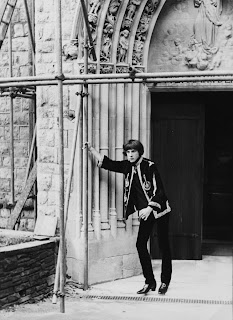
Stash Klossowski De Rola in Mayfair, London, during a photo shoot for Rave magazine, 1966.
The Pop Prince - a feature on Stash in Rave magazine, 1966 (click to enlarge).
Although he remained a fringe character in the music industry, Stash was very much at the centre of a Swinging London scene. He was a regular in clubs such as Ad Lib or Speakeasy where he hung out with The Animals, Jimi Hendrix and The Who, among others. It was an era of new dandyism, and Stash's love of fabrics such as silk and velvet made him a perfect 'peacock'. He also collected vintage clothing. In the article in Rave magazine talks about his new jacket - From Damascus - Not Carnaby Street. I'd never wear clothes that everyone else could get hold of. In fact, I've just bought a 'new' coat made in 1718 - it's the only thing I've seen that I like (Rave, 1966).
Stash in June 1967. He is wearing a Kangaroo fur coat given to him by Brian Jones. Brian wore the very same coat on the cover of Between The Buttons album.
My love for satin , velvet and lace goes back to my childhood, and from the earliest times I had an acute sense of what I wanted to wear, for better or ill.(...) In 1961-1962, I appeared in a French film directed by Marc Allegret called 'La Demon De Minuit', and therein played a part of star photographer, whose costume I selected, wearing silk embroidered cuffs and a satin cape. In the 60's, one began to stress one's growing eccentricity with ever more elaborate costumes (Ugly Things, p 82)
Anita Pallenberg, Brian Jones and Stash Klossowski De Rola at Cannes Film Festival, May the 6th 1967.(Photo credit: Hulton Archive)
Brian Jones and I would visit a store on the King's Road owned by Ola Hudson, the mother or Slash, who was then a toddler, and grew up to become a famous contemporary guitar player (of Guns n' Roses fame).There we would buy antique women's clothes that we would fashion as tunics. We referred to it as 'scoring chick's clothes'. The late great decorator Ben Willis presented me with the famous Arab velvet jacket embroidered with gold, which I wore on countless photoshoots, and that Brian Jones also wore on several occasions. I was also partial to wonderful psychedelic Nehru jackets designed by Chris Jagger and frequently exchanged clothes with Jimi Hendrix, Mick Jagger, Brian and Keith Richards (Ugly Things, p 82).
Brian, Stash, Anita Pallenberg and film director Volker Shlondorff at Cannes, May the 6th 1967.(Photo credit: Hulton Archive)
In 1969 back from India and Morrocco, I took to wearing Syrian wedding dresses and white Arab robes. In 1970 while working in Hollywood and touring with Joe Cocker, I bought a racing driver suit worn by Elvis Presley in the film with Nancy Sinatra, and a pirate shirt at the MGM auction of costumes. The latter I took to Sri Lanka, I redesigned and modified it. Then I ended up eventually giving it to Keith Richards who wore it on tour. It was eventually sold and can be seen online (
Ugly Things, p 82).
Brian Jones and Stash exit West London Magistrates Court - June 2nd 1967.
On May the 10th 1967, Brian Jones and Stash were arrested in London on drug charges. Today, it is almost certain that the drugs had been planted. Although eventually cleared of all charges, the trial was a traumatic experience for Stash: Instead of starring in John Huston film in Hollywood with my fiancee Romina Power, I was deprived of my passport, forbidden to travel, and both my career and my reputation were in tatters (Ugly Things p 83). Even his own lawyer showed a certain degree of hostility: I was defended by Sir David Napley, who infuriated me by querying: 'But you, Sir, are a gentleman, what on earth are you doing with those chaps?' - the latter term he stressed in a disgusted, contemptuous manner (Ugly Things, p 83).
Stash and Brian Jones leaving the court, June the 2nd 1967.
During the trial, Stash's friends proved to be a great support - most notably Paul McCartney, who invited Stash to stay at his house throughout the trial. Unfortunately, Brian Jones, according to Stash, followed the advice of his lawyers to stay away from Stash and the rest of the Stones, which had a disastrous effects on his mental state: Deprived of our company, he fell into really bad habits, used downers indiscriminately, and his paranoia led to his literally falling to pieces and his musical ability suffered badly. I blame the police, as a tool of stupidly conservative reactionary climate, for provoking this crisis that led to his estrangement from the Stones and his ultimate demise (Ugly Things, p 83).
Apart from Brian Jones, Stash Klossowski De Rola had also known another doomed dandy of 60's London - Syd Barrett. At the end of 1967, Stash, Syd, and few friends went on a acid-fueled trip to Wales - the trip that ended up with Syd lost in magical dimension. I have given several detailed interviews on that one. It is hard to condense that entire stay in Black Mountains. including those fateful events in a few necessarily glib sentences.(...) Having heard that Syd has never recovered and what had ensued, I had concluded that the only possible way to turn back the clock was to go back to that dimension and liberate him. It would have been something somewhat akin to the Luis Bunuel film 'The Exterminating Angel' (Ugly Things, p 84).
Stash with his fiancee - model and actress Romina Power,1967.
Being an eligible Swinging London bachelor, Stash had plenty of romances with beautiful women: The list of women that I loved and bedded who are somehow connected to rock is endless over the last 49 years or so, and include Joan Blackman (Elvis' lead lady in 'Kid Galahad' and 'Blue Hawaii' - Peter Marham), Tuesday Weld, Gretchen Burrell, Phyllis Major, Nico, Anita Pallenberg, Marianne Faithfull, Suki Poitier, Linda Eastman etc etc. I do not want to brag, but sex, and lots of it with beautiful models, movie stars and groupie queens was a daily occurrence (Ugly Things, p 84).
Stash and Romina Power, 1967
In 1967, Stash did an infamous photoshoot in his family mansion Villa Medici. The photos, initially intended for Playboy ,were aiming to outshine tasteless lifestyles of American playboys. Stash, dressed in his best peacock attire, posed with two nude models, Marayat R. and Liz Thompson.
Although , the project was abandoned halfway through, the photographer James Baes had sold the photos to an Italian magazine Playmen in 1968. The photos caused scandal at the time and angered Stash' father. Luckily, at the time Stash was traveling through India, and when he came back at the end of the year, the photos were almost forgotten about and he was only mildly told off (Ugly Things, p 85).
I never really looked at the 60's as a proper decade - says Stash - It began as the 60's in 1964 and quite possibly continued until 1974 (Ugly Things, p 85). Indeed, the early 1970's brought more excitement for Prince Stash Klossowski de Rola: A role in a Hollywood production Rutabaga Deluxe alongside Gram Parsons, writing scripts for Roger Vadim, playing in Joe Cocker's band, hanging out with Marlon Brando,numerous trips to Ceylon, and another drug bust - this time with Keith Richards in 1973.
Stash with Keith and Anita in 1973
Prince Stash Klossowski De Rola was one of the greatest European dandies of his era. Not surprisingly, he is currently writing an autobiography in which he talks extensively about his family, the 60's, Stones, Beatles and anybody else he had a fortune to have met.
Stash in his current home - Castle of Montecalvello, summer 2010
(Photo: Karin Smatt Robbins)
ACKNOWLEDGEMENTS: Many thanks to Mr. Peter Markham, who has sent me his interview with Prince De Rola, as well as all the pictorial evidence seen in this post. Also, I'd like to thank Ms. Jayme Franklin who owns the copyrights to some of the photos.