I am not exactly what you'd call a 'movie buff', but I do love discovering great obscure flicks from 1960's. The genres I am particularly obsessive about are: early 60's British 'Kitchen Sink' dramas, 'Swinging London' films and psychedelic weirdness from both, Europe and America. It is a sheer joy to discover long-lost 'Kitchen-Sink' masterpieces like
Term Of Trial (1962) with Laurence Olivier or
The Party's Over (1963) with Oliver Reed, interesting art-house B-movies like Jess Franco's
Venus In Furs (1970), or Swinging London madness of
Here We Go Round The Mulberry Bush (1967). But every now and then, you inevitably get burned - you discover an absolute dud. In this day and age, when no film is really 'lost' anymore, flops and failures of bygone eras are re-emerging on DVD. What's worse, some of them undeservedly earn status of 'lost classics'. Here, I have compiled a little list of films to avoid - I have wasted a lot of time watching them and I warn you not to waste yours. Nearly all of them flopped at the time of the cinematic release, but now are easily accessible on DVD or YouTube . Tempted by a good cast, good director, cool poster (or all of it combined) you may feel like you want to see some of them. Well,believe me, you don't. I tried to focus on films which are absolutely unwatchable - not only they are badly written or/and actors are miscast, but there is nothing else to hold your attention - no amazing sets, costumes,music, nudity or erotic scenes ( Just to note - I tried to avoid blatant B-flicks, therefore no Roger Corman, Russ Meyer, Hammer films etc.). So, I present you 10 lost 60's classics that should have remained lost....
10. PETULIA (1968)
Director: Richard Lester
Cast: Julie Christie, George C. Scott, Richard Chamberlain
In 1968, American expatriate Richard Lester was one of the 'hottest' directors in Britain. Having made
A Hard Day's Night (1964) and
Help! (1965) with The Beatles, as well as brilliant Swinging London comedy
The Knack...And How To Get It? (1965) and John Lennon vehicle
How I Won The War (1967), Lester was now heading back to his homeland to conquer Hollywood. Julie Christie , after her appearance in David Lean's epic
Doctor Zhivago and her Oscar-winning role in
Darling (1965) was also at the height of her fame.It seemed like a match made in heaven - pairing up Richard Lester with Julie Christie should have resulted in one of the funniest comedies of 1960's. Instead, it resulted in this strangely lucklustre drama about abused housewife (Christie) who starts an affair with a divorced doctor (Scott). The film doesn't work, because Lester could not decide what kind of film he wanted to make. In
Petulia, he abandoned his trademark absurd humour, perhaps wishing to move into more 'serious' territory'. But the film oscillates somewhere between comedy and drama, and as a result ends up being neither. It's not funny enough to be a comedy, and not serious enough to be a drama. It's just plain dull. Julie Christie had a flair for bringing out comical undertones in dramatic roles, which she showed so well in
Billy Liar (1963), fore-mentioned
Darling and period drama
Far From The Madding Crowd (1967) (all three films were directed by John Shlesinger), but we see none of it in
Petulia. She tries too hard to make her character kooky (I hate that word) and ends up being just plain annoying.Also, what is going on with her hair!? Is it a wig? It looks terrible....
The film has a small bonus in a form of performances from Grateful Dead and Janis Joplin. Find it on YouTube, but don't bother with a rest of
Petulia. That poster looks retty cool, though. It's such a shame that the scene depicted in it doesn't actually occur in the film...
9. CASINO ROYALE (1967)
Director(s): Val Guest, Ken Hughes, John Huston, Joseph McGrath, Robert Parrish
Cast: Peter Sellers, David Niven, Ursula Andress, Orson Welles, Woody Allen, Deborah Kerr, Jean-Paul Belmondo
The rights to this James Bond novel were sold in late fifties, before Albert Broccolli and Harry Saltzman bought the rest wholesale from Ian Fleming. In 1967, the owner, Charles K. Feldman, not wanting to compete with 'proper' versions of Bond, decided to film it as a pastiche and recruited a cast of A-list stars such as David Niven, Peter Sellers, Ursula Andress, Orson Welles and young Woody Allen. On paper it sounded like a brilliant idea. So what went wrong?
Well, the answer is Peter Sellers. Reportedly he was very difficult on the set, showing up and disappearing whenever he felt like it, and constantly disrupting the filming with various shenanigans. Four directors, including legendary John Huston, walked out of the project, unable to work with him. Orson Welles hated Sellers so much, that he refused to be in the same room as him, even during shooting of the scenes in which they were together, which made a shooting difficult, to put it mildly. Not surprisingly the result was a total chaos.
Casino Royale doesn't have anything even remotely resembling a coherent plot. Some men, all of them claiming to be James Bond, chase some nice looking ladies around, but that's about it. It is very hard to sit through more than fifteen minutes of this mess. My only question is: How can a film (or even a mess) with Peter Sellers and Woody Allen in it - possibly the greatest comics of all time - be this unfunny?
(As all of the Bond fans surely know, the proper version of
Casion Royale was filmed in 2006)
8. GIRL ON A MOTORCYCLE (1968)
Director: Jack Cardiff
Cast: Marianne Faithfull, Alain Delon
The thought of Marianne Faithfull wearing a leather jumpsuit and nothing underneath sounds quite appealing, doesn't it? Well,my dear male reader, you gonna have to rely on your imagination to picture it, because although this film promises a lot, it delivers very little - it's nowhere near as erotic as you might think. If it's nude Marianne Faithfull you're after, then I must disappoint you. You can see about as much of her skin on this poster as throughout the whole film. It is a dull story of two pretty dull people having an affair. I think one of them is married, but I can't remember which one. In fact, I am struggling to remember anything about this film whatsoever, even though I saw it twice. Alain Delon gives probably the worst performance of his career. What was he doing in this film anyhow? I can understand why Marianne Faithfull took the role, but why did he?
Anyway, I am gonna save you an hour an half of utter boredom - she dies in a motorcycle crash at the end. Now you really don't have a reason to watch it.
I've noticed that a lot of people get my blog after typing into google 'Marianne Faithfull nude'. I have no idea why. But since there's a demand, there should be a supply..
Her brief cameo in
I'll Never Forget What' isname (1967), a comedy by Michael Winner with Oliver Reed. As naked as she ever got in any film....Enjoy!
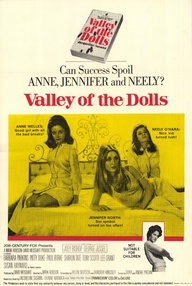
7. VALLEY OF THE DOLLS (1967)
Director: Mark Robson
Cast: Sharon Tate, Patty Duke, Barbara Parkins, Lee Grant
Very poorly adapted from a bestselling novel by Jacqueline Susan,
Valley Of The Dolls is a story of three young actresses and their adventures in harsh and unforgiving world of show business. I say 'poorly adapted' because the script tries to squeeze too much action from the novel into the film , which as a result is way too long. Film focuses on characters of Anne (Barbara Parkins) and Neely (Patty Duke), but in a way which doesn't really reveal anything about them as characters. They both seem so fake and phoney that it is impossible for a viewer to relate to them, or believe in existence of people like them in real life. The only interesting character, Jennifer (Sharon Tate) - a doomed starlet who marries mortally ill singer, and takes roles in porn movies to pay for her husband's health care - is kept in the background. Also, the passing of time in the film is not indicated in any way. The story is presumably spread through several years, but not only the characters don't age, but the reality around them - the cars, the costumes does not change. A simple credit at the bottom of the screen saying '2 years later' would definitely help in some of the scenes.
If you're hoping for a '60's vibe' in this film, you will be disappointed - there isn't any. Although made in 1967,
Valley Of the Dolls feels like a film made in early 1950's.Everything in it screams of 1950's - beginning with costumes and sets, through 'safe' handling of a controversial subject ('dolls' was a slang word for amphetamine pills abused by all three characters) to characters' hopes and aspirations; the way they talk and act, etc. Not to mention the suited crooners and the general old-fashion-musical feel. Even in 1967, this film must have looked like a relic of a bygone era. Today it just looks dated beyond pardon. The only reason anybody ever watches it, is the rare appearance of Sharon Tate - at the time wife of Roman Polanski, and future victim of a murder from hands of Charles Manson's Family. She reportedly hated the book, the film and her own appearance in it. It's hard to blame her.
6. MODESTY BLAISE (1966)
Director: Joseph Losey
Cast: Dirk Bogarde, Monica Vitti, Terence Stamp
With this cast and director, this should have been one of the greatest British films of the 1960's. Previous collaboration of Losey and Bogarde resulted in my all-time favorite
The Servant (1963) - a criminally underrated masterpiece. Monica Vitti was a star of Michelangelo Antonioni's Italian films and Terence Stamp - a 'Swinging London' bachelor was also a star on the rise, especially after the role in critically acclaimed
The Collector (1965). So why on earth did any of them agree to appear in this dismal adaptation of mediocre spy novel? Neither the director, nor the actors really 'felt' the genre, and unfortunately it shows. The most uncomfortable one was Bogarde as a pantomime villain in a ridiculous blond wig. Monica Vitti spoke very little English at the time, and some of her lines sound like they were learn phonetically. Terence Stamp gives possibly the most forgettable performance of his career. The filming was apparently constantly disrupted by arguments between Losey and Vitti. Dirk Bogarde was not getting on with his Italian co-star, either. He remarked (years later):
I fell in love with every woman I ever worked with. Except for Monica Vitti. The resulting film was embarrassingly bad. In a first fifteen minutes, so many characters are introduced , and so little about their motives is revealed, that you simply lose track of what is going on. Soon after, you lose interest. This film doesn't even have that campy quality which makes
Barbarella or
Danger: Diabolik so appealing.
Modesty Blaise flopped and was disowned by anybody who had anything to do with it. Joseph Losey soon redeemed himself with brilliant
The Accident (1967) which also starred Dirk Bogarde. Monica Vitti returned to Italy where she remained a big star. But
Modesty Blaise had a destructive effect on Terence Stamp's career - not only did he turn down the role in
Alfie to star in Losey's film, but
Modesty Blaise also deprived him of the leading role in
Blow-Up. He was Antonioni's original choice for the role, but Italian director was obsessively jealous of his muse Monica Vitti and he constantly suspected her and Stamp of having an affair (something Stamp always denied). Few weeks before shooting
Blow-Up, Antonioni replaced Stamp with then-unknown David Hemmings. Terence Stamp is bitter about it to this day.
5. PRIVILEGE (1967)
Director: Peter Watkins
Cast: Jean Shrimpton, Paul Jones
The idea - just the idea, mind you - sounds vaguely interesting. A pop idol is used by his evil, manipulative managers to spread destructive message to the adoring fans. It ceases to sound interesting and start sounding ridiculous when you find out, that the message is not consumerism or permissiveness but....Christianity.
Steven Shorter (Paul Jones) is a hysterically adored pop star (imagine Lennon, Jagger and Dylan rolled into one). Lonely at the top and sent halfway to bedlam by his hectic touring schedule, Steven meets a young painter (Jean Shrimpton) and the two begin an affair. At the same time, unbeknownst to Steven, his managers team up with a sinister religious dignitaries, who worried about growing godlessness among youth, decide to re-invent Steven Shorter as born-again Christian in hope of converting the masses.
What did not work here was a pair of film's main stars. Casting musicians and models in films can bring interesting results (Mick Jagger in
Performance or Twiggy in Ken Russell's 1920's extravaganza
Boyfriend (1972
)). Here, it failed miserably. The acting skills of Paul Jones and Jean Shrimpton are almost non-existent. Jones, who in real life was a lead singer of Mod/Rn'B hit-makers Manfred Mann, is particularly irritating. He wants to make the character of Steven 'troubled' and 'mysterious', bu instead he comes across as 'arrogant' and 'bored', leaving viewer wondering what the hell all these screaming teenagers see in him. His godawful stage act, worthy more of a first-year Perfoming Arts student rather than a biggest star in the world, only adds to that impression. Even worse is Jean Shrimpton - wooden to the point of comical and almost inaudible.
Paul Jones and Jean Shrimpton during filming of Privilege. Shrimpton had this exact facial expression throughout he whole film.
Terence Stamp, who was Jean Shrimpton's boyfriend at the time, tried to talk her out of taking the role in Privilege, sensing the lack of her acting skills. Shrimpton got so offended, that she dumped him (that sent Stamp in a downward spiral of depression, which some time later resulted in him quitting acting for a few years).
The silliness of the plot in Privilege resulted in some truly cringeworthy scenes - like the one where the whole stadium shouts 'We will conform!' - did director Peter Watkins really thought that low of young people? The rise of counterculture and anti-war protests in 1967, made Privilege irrelevant practically on the day of its release.Slated by the critics for a half-baked concept and bad acting, and ignored by the public, Privilege disappeared, not to be seen for another 43 years. Unfortunately, in 2010, BFI remastered and released this dud on DVD. Don't buy it, unless you run acting class and want to show your students what 'bad acting' means...
4. TWO-LANE BLACKTOP (1971)
Director: Monte Hellman
Cast: James Taylor, Dennis Wilson, Warren Oates
Made in 1971, so technically not a sixties film, but it certainly tried to captured he spirit of the decade just gone. Some film aficionados might try to convince you that this film is 'like Easy Rider or Vanishing Point, but cooler'. It's a spot-on description, but only if by 'cooler' they mean 'a mediocre rip-off and blatant attempt to cash-in'.
Film tells a story (if you can call it that) of a racing driver (James Taylor) and his mechanic (Dennis Wilson). They pick up a hitchhiker (Laurie Bird). Not much happens and not much is said. The girl mostly looks bored while driver and mechanic talk about cars. They meet another racing driver (Warren Oates) who challenges them to the cross country race to Washington. To be honest, I've only seen it once, about five years ago, and all I remember was a general feeling of boredom, and a mental note to myself not to ever give it another chance (which means I must have really hated it)
It's another example of the film where casting musicians did not work out. James Taylor's acting is about as dull as his songs. Dennis Wilson - The Beach Boys' drummer - had a movie star good looks, not quite matched by his acting ability.
If you're into Easy Rider vibe, there are some other great films from 60's/early 70's era. If you like films about American hippie Counterculture, I recommend The Strawberry Statement (1969) or Getting Straight (1970) or even Antonioni's Zabriskie Point (1970, a failure, yes, but at least an interesting one). If it's pure road cinema you're after I recommend almost forgotten Scarecrow (1973) with Al Pacino and Gene Hackman. Just don't waste your time on Two-Lane Blacktop.
Director: Christian Marquand
Cast: Richard Burton, Marlon Brando, James Coburn, Walter Matthau, Eva Aulin, Ringo Starr, Charles Aznavour
Terry Southern.....at his best he co-wrote a script of
Dr. Strangelove with Kubrick and helped Peter Fonda and Dennis Hopper to write
Easy Rider. At his worst he was responsible for
Candy. The film was based of Southern's 1958 novel (co-written with Mason Hoffenberg) which in turn, was very, very loosely based on Voltaire's
Candide.
Film is a story of Candy (Eva Aulin) and her erotic journey through modern America. During that journey she meets an eccentric writer (Richard Burton), insane general (Walter Matthau) , hapless Mexican gardener (Ringo Starr), sinister surgeon (James Coburn) and suspicious Guru (Marlon Brando). We don't know why the journey is happening, where is she going, and to be honest we don't know what is going on most of he time. The film was supposed to be a satire on something, presumably contemporary America, but frankly, even a 10 year old child would be capable of wittier observations than the ones made by the film. Eva Aulin - former Teen Miss Sweden, in a film often loses parts of her outfit - at tines her entire outfit - but unfortunetely, even that doesn't make the film any more watchable.
Neither do all the star cameos. Most of them were friends of Terry Southern or Christian Marquand who charged no fee or a reduced fee. Neither one of them will count
Candy as their best moment.The film of course flopped. Not that Terry Southern learned a lesson. Year later, in 1969, he was involved another film based on his script and made in very similar vein -
The Magic Christian with Ringo and Peter Sellers (admittedly slightly more watchable than
Candy).
Eva Aulin and Ringo Starr at the premiere of Candy, 1968
2. 200 MOTELS (1970)
Director: Frank Zappa
Cast: Ringo Starr, Keith Moon, Pamela Des Barres
OK, let me put it straight: this is not a film! It's a CCTV footage! Frank Zappa, who directed this thing, was one of the finest musicians of his generation, but should have not been let anywhere near a camera. I say 'directed' but it's hard to see signs of any direction. He might have as well left a rolling camera at the Hot Rats launch party (actually, no - that makes it sound almost watchable). Normally you could blame drugs, but Frank Zappa, apparently wasn't doing them at all.There's no excuse for this. Don't get me wrong - I am all for psychedelic nonsense. I love Magical Mystery Tour or The Monkees' Head. But this!!? This is just a waste of celluloid tape. There is no plot, there aren't even any characters, just a bunch of people shouting over each other - among them Ringo in a ridiculous wig, looking very confused , and the Who's drummer Keith Moon. There is a chance that you might have heard of 200 Motels through I'm With The Band - an autobiography of Pamela Des Barres - late 60's/early 70's LA groupie queen. She talks about the film quite extensively. I am not sure why she bothered to mention it at all - especially since her own appearance lasts about fifteen seconds during which she says one line (dressed as a Nazi dominatrix). How could this rubbish ever get a cinematic release, I will never now. And why did anybody bother to release it on DVD?
1.SYMPATHY FOR THE DEVIL (A.K.A. ONE PLUS ONE) (1968)
Director: Jean-Luc Godard
Cast: The Rolling Stones
In the words of Dante Alighieri,
Abandon hope, all ye who enter here.....
Now, I would lie if I said I was a fan of Jean-Luc Godard. There is so much I hate about his films, that I don't even know where to start... His annoying male protagonists, who always act like prepubescent boys. His adolescent views on love and sex. His tendency of bombarding a viewer with meaningless political slogans..His at best childish grasp of politics, especially Socialism and Communism...I could go on and on. OK, so
Breathless (1959) is an important film. Some of his early 1960's movies are watchable, mostly thank to the sheer physical beauty of his leading ladies. After all, who can resist the charms of Anna Karina in
Vivre Sa Vie (1961), Brigitte Bardot in
Le Mepris (1963) or Chantal Goya in
Masculin Feminin (1964)? But, when deprived of distraction in form of a beautiful actress, his films are inevitably exposed for the pretentious, dull duds that they are. First sign of that was
Weekend (1967) - film so irrepressibly awful and boring, that they should screen it to convicted criminals as a punishment. You'd think hat making a worse film was hysically not possible. Unfortunately it was.....
Godard had quite a lot of hopes connected with
One Plus One. Initially, he wanted to recruit The Beatles (whom he always criticised for not being political enough). He had a meeting with John Lennon in London, during which he refused to reveal absolutely anything about the project. Suspicious Lennon turned him down. Mick Jagger, on the other hand, jumped into opportunity - he always wanted to work in movies (that was before
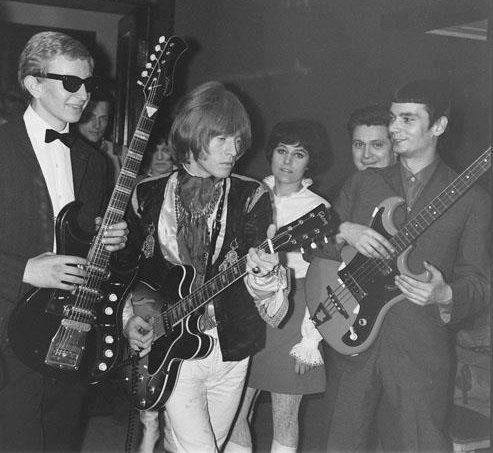
Performance). The scenes with The Rolling Stones shot at Olympic Studios are nothing more than a simple documentary - Stones work on.....That's right, 'Sympathy For The Devil'. We can see a development of the song from a slow, acoustic ballad to its final form with bongos, and electric guitar. What we can also see is Brian Jones in a very bad condition - he seems completely detached from what is going on in the studio.
Brian Jones and Jean-Luc Godard, 1968
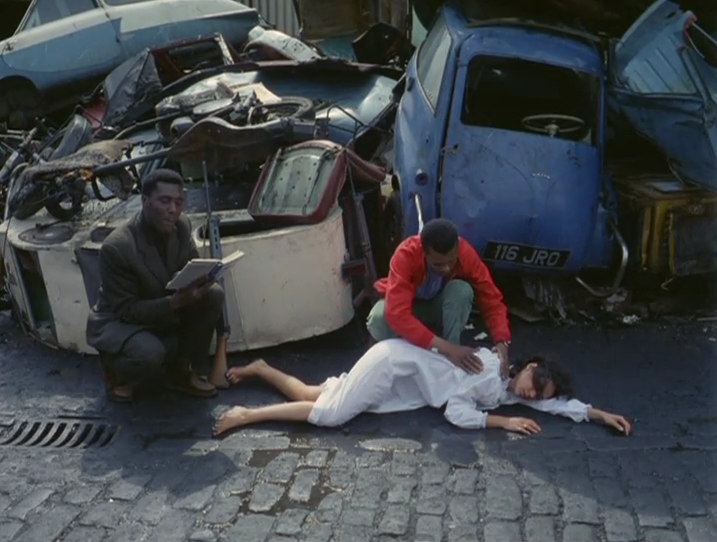
Although the scenes with The Stones are pretty dull, they are probably the best in the whole film. Other scenes include: woman walking around the forest and giving an interview about Socialsm. Iain Quarrier (known from Wonderwall, Fearless Vampire Killers and Cul-De-Sac; also the producer of One Plus One) walking in circles around newsagents reading Communist Manifesto, and Black Panthers on the car park somewhere in Battersea (and what would they be doing in Battersea?) reading Black Panther Manifesto, and shooting three women for no apparent reason. In other words, the usual boring, pretentious rubbish that Godard was known for.
Initially, Godard wanted to get rid of all the scenes with Stones, but producer Iain Quarrier disagreed. What's more, he demanded for the title to be changed into Sympathy For The Devil (he knew that The Stones were the only thing in the film that would attract any audience). Two men got into a heated argument during which Godard called Quarrier a fascist.
Godard first unveiled this film during Cannes festival in 1968 which coincided with infamous May 68 riots. A passionate socialist, Godard, along with Francois Truffaut and few other Nouvelle Vague directors, demanded putting festival on hold to demonstrate solidarity with strikers in Paris. What's more, he wanted a complete nationalisation of French Cinema, which he felt should be under 'worker control'. He got into a heated argument with Roman Polanski who was there to present his hugely successful Rosemary's Baby. Polanski, a Polish expatriate, who unlike Godard or Truffaut actually experienced life under Communist regime was unimpressed. He rightly noted: People like Godard and Truffaut are like little kids playing at being revolutionaries. I've passed through this stage. I was raised in the country where these things happened seriously (Christopher Sandford, Polanski, p 159). Godard called Polanski a fascist and told him to 'fuck off to Hollywood' (He had an annoying habit of calling a fascist anybody who disagreed with him).
When Sympathy For The Devil was finally premiered , nobody was impressed. Apart from the Stones bits, which have a value as a documentary, the film deserves to be flushed down the toilet.
So there it is. I think I made my case. If you think that I got something terribly wrong, do speak up. Any additions to the list are also welcome.
BIBLIOGRAPHY
Jurgen Muller, Movies of The 60's, Tashen, 2004
Peter Doggett, There's A Riot Going On, Cannongate, London, 2007
Peter Biskind, Easy Riders And Raging Bulls, Simon & Shuster, London, 1998
Christopher Sandford, Polanski, Century , London, 2007
The Real Blow-Up, BBC Documentary, 2002


.jpg)


.jpg)

.jpg)
.jpg)

.jpg)


.jpg)