Showing posts with label Pink Floyd. Show all posts

Saturday, 1 June 2013

"Groupie" By Jenny Fabian


I finally got round to reading Groupie by Jenny Fabian and Johnny Byrne. This book, first published in 1969 quickly achieved cult status for more than one reason. Not only it was the first detailed insight into the groupie phenomenon and the world of sex, drugs and Rock n' Roll, but it was also the first  time the quintessential sixties slang was used in English literature. As Jonathon Green wrote in the preface to the 1997 edition: "Groupie" gets 22 citations in the Oxford English Dictionary from "downer" to "trippy" and "spliff" to "uptight", a mini-lexicon of Sixties-speak (p. iv).
The book itself is a fictionalised account of London's sixties underground music scene by  real-life groupie Jenny Fabian. I say 'fictionalised', but there's very little actual fiction in the novel - the names of bands, members, places,etc. are probably the only departure from reality. And everybody knew who the musicians in the novel were, anyway...Here's a list of the names in the book and their real life equivalents...

Satin Odyssey = Pink Floyd (Ben = Syd Barrett)
Big Sound Bank = Zoot Money's Big Roll Band
The Transfer Project = Dantalian's Chariot (Davey = Andy Summers)
The Savage = Eric Burdon & The Animals
The Dream Battery = The Soft Machine
Jubal Early Blowback = Aynsley Dunbar's Retaliation
Relation = Family (Joe = Ric Grech, Grant = Family's manager Tony Gourvish)
The Elevation = The Nice (Andy = David O'List)
The Shadow Cabinet = The Spooky Tooth
The New York Sound And Touch = The Fugs
The Jacklin H. Event = The Jimi Hendrix Experience (Sam = Mitch Mitchell)


Unlike Pamela Des Barres's I'm With The Band, which was written from a perspective of a few decades, Groupie was written and published within few months in 1969. It can be seen as an advantage - all the events were still fresh in author's memory. But it can also be a disadvantage. The book is almost like a diary - there is not much of a story developing here, and the plot does not progress towards any sort of conclusion. It is strictly an account of what Katie (Jenny Fabian, obviously) does, without much of an introduction or ending. The book does not end - it cuts off, more like. Still, it provides a great insight into psychedelic underground of Swinging London. Most of the events in the book take place in 1968. It starts off with a graphic description of Katie's one night-stand with Ben of Satin Odyssey - Syd Barrett, literally days before his departure from Pink Floyd, who was already in a very bad mental state. Throughout the book, Katie has many one night-stands with various musicians, but she also has three 'regular' boyfriends - first it's Davey (Andy Summers), and then, when she moves in with Relation (Family) she has a love triangle with Joe (Ric Gretch) and Grant (family's manager Tony Gourvish). Some of the musicians are portrayed by Fabian in a quite a positive light, others less so. She was clearly infatuated with Andy Summers (Davey in the novel) - and she describes their affair as happy and harmonious.

 Andy Summers circa 1968

1968 was a busy year for Andy Summers. He played guitar for Zoot Money's Big Roll Band and their psychedelic side project, Dantalian's Chariot, with whom he scored a small underground hit, 'Madman Running Through The Fields'.


Dantalian's Chariot, 1968


Around the summer 1968, Andy Summers joined The Soft Machine as a touring guitarist, and went with them to America, which put an end to his relationship with Jenny Fabian (although he was writing her passionate love letters). After the tour ended, he stayed in America,where he briefly joined late incarnation of The Animals. He reappears at the end of the book - him (Davey) and Jenny (Katie) decide to stay friends and he contemplates quitting music and going to acting school (which didn't happen - he stuck to music, eventually achieving stardom in the late 1970's as the guitarist of The Police).

After Davey's departure to America, Katie starts a relationship with Joe from Relation (Family's Ric Gretch). Now, if there's a villain in the book, it's Joe. Fabian portrays him as misogynistic, manipulative and generally rather nasty (and at the same time weak-willed and rather insecure).


Jenny Fabian (left) and Ric Gretch (centre), circa 1968

  She dumps him for Relation's manager, Grant - probably the most complex of all the characters. Very masculine, dominating and also quite misogynistic, yet at the same time with a surprising soft side. Him and Katie have a pretty complicated relationship (which doesn't stop Katie from her pastime as a groupie).

Although she gets mistreated by a lot of men, surprisingly, you never hear Katie moaning about how rubbish men are - in fact, she enjoys mind games, which clearly shows in her relationship with Grant. Still, a lot of things written in the book indicated that sexual liberation and free love did not work as well as young people wished.

Katie is also quick to mention that she is not just a groupie - throughout all the time she works - first as a journalist, and then as booking agent/door girl for the hip club The Other Kingdom - Middle Earth, in real life.


Logo and poster for a gig at Middle Earth, 1968

Middle Earth was a club in Covent Garden, famous for the psychedelic light projections. Anybody who was anybody played/was seen there between 1967 and 1968.  In Groupie, Jenny Fabian provided some interesting insight into how the club operated. 

 In 1968, Middle Earth moved from Covent Garden to a bigger venue - Roundhouse in Camden. There, it hosted even more high profile gigs - here's a poster for Doors/Jefferson Airplane concert, which Jenny Fabian mentions in the book - exceptionally using real band names.


Poster by Alan Aldridge for Led Zeppelin's gig at Middle Earth

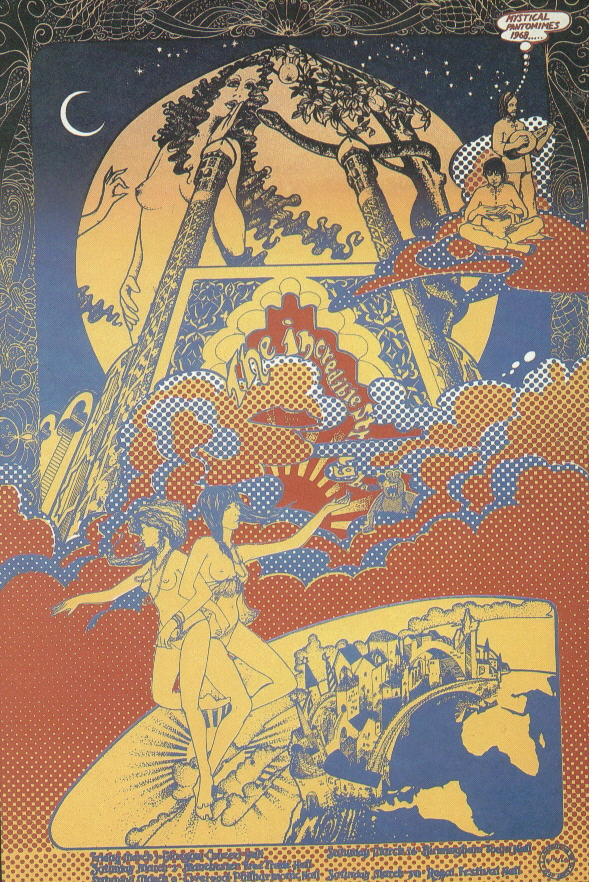
Poster by Michael English for an event at Middle Earth, 1968

Jenny Fabian was also involved in organising the ill-fated International Pop Festival in Rome,  about which she talks extensively in Groupie.


Poster for International Pop Festival in Rome by Michael English, 1968.
Jenny Fabian in 1968

All in all, Groupie makes an enjoyable reading, especially to those who are into 1960's. It gives a fascinating insight into the scene, the music and the language of 1960's Swinging London. What struck me most about it was how clear the divisions between 'us' and 'them' were. You could tell  (as Katie in the book often does) almost instantly by somebody's clothes, language which category a newly met person was falling into. It was a kind of generational unity which does not seem to exist today. What a shame...


Dutch edition of Groupie, that's what I call a cool cover..


Source of the images: London Live by Tony Bacon, London Grip,tumblr, The Groupie website, Magic Mac  
     

Tuesday, 9 April 2013

Michael English And Psychedelic Art Of Hapshash And The Coloured Coat


The Soft Machine poster, 1967

Some time ago I bought this book (from 1979) about the art of Michael English, titled 3D Eye. It is the collection of posters, prints and paintings of Michael English from the period 1966-1979. Large part of the book is devoted to the years 1966-1968, when English was a part of a design collective Hapshash and the Coloured Coat, which specialised in making psychedelic posters for London's counter-cultural underground.

Michael English was born in Bicester, Oxfordshire in 1940. After quitting his first job at the BBC animation studios (reason: boredom), he enrolled at the Ealing College of Art. After completing his course in 1962, he went on to work in an advertising agency. Then, in 1965, he met Tom Salter, owner of Gear boutique.  English started designing various items for Gear: screen-printed carrier bags with slogans like 'Sex' or 'Kiss Me', sunglasses covered with Union Jacks (possibly the first appropriation of it as a Pop Art aesthetic) and T-shirts with a slogan 'Jesus Saves' printed in 3-D. His work got him a lot of attention, especially from various figures from bourgeoing psychedelic underground scene, like John 'Hoppy' Hopkins, who would soon comission English to design the poster for 'Love Fesival'.


Around that time, Michael English painted facades for 'hip' new boutiques - Granny Takes A Trip (below, left) and first  Hung On You on Cale Street.


One of the owners of Granny's - Nigel Waymouth (also a graphic designer) became good friends with English, and soon the two started design group Hapshash and the Coloured Coat, who would go on to design some of the most memorable posters of British psychedelic movement.
This is how English remembers his time as he member of Hapshash: Before the posters I was involved in my own kind of Pop Art. Done on my own, the first two paintings were mainly a development of that, but 'Love Festival' was greatly influenced by the work of two artists: Man Ray's painting of lips in the sky - I forget the title - and the lips of women in the work of American Pop artist Tom Wesselman (...).At the same time I was fascinated by the sinuous yet romantic shapes found in Mucha's posters and the work of Beardsley and Rackham. Meeting Nigel brought this to life; I responded to his romanticism. All the Underground posters are packed with secret signs, prehistoric forms and flying saucers.We believed and adopted anything that contradicted the rational world: our science was rooted in alchemy and black magic. Sexuality too was a strong force and there is a lot of happening in the posters. Dragons and pubic hair! (Michael English, 3D Eye, Paper Tiger, Limpsfield, 1979 , p 12).

Poster for 'My White Bicycle' - single by Tomorrow, 1967

Poster for The Jimi Hendrix Experience gig at Fllmore Auditorum, 1967

Love Me - poster by Hapshash and Coloured Coat, 1967

Crazy World Of Arthur Brown, The Soft Machine and Liverpool Love Festival at UFO, 1967

Pink Floyd at UFO, 1967

Julie Felix in Royal Albert Hall, 1967


Poster for Crazy World Of Arthur Brown gig, 1967


Save Earth Now - poster by Hapshash and The Coloured Coat, 1967


Poster advertising 'I Can See For Miles' by The Who


Michael English: Nigel Waymouth worked with me on each poster. Nigel would do a bit and i would add to his work and he to mine until the poster was complete. The posters were silk-screened. the artwork for each colour was transferred to its own individual screen and the elements of the image were married together in the actual process of printing. We developed our own technique of putting two or three colours onto the screen, merging them together as the squeegee was pulled across. that was our most successful innovation. We used metallic and fluorescent inks - day glo! (English, p 12).


Poster for Incredible String Band tour, 1967


Poster for 5th Dimension club in Leicester, 1967


Poster for Middle Earth club in Covent Garden, 1967


Poster for International Pop Fesival in Rome, 1968

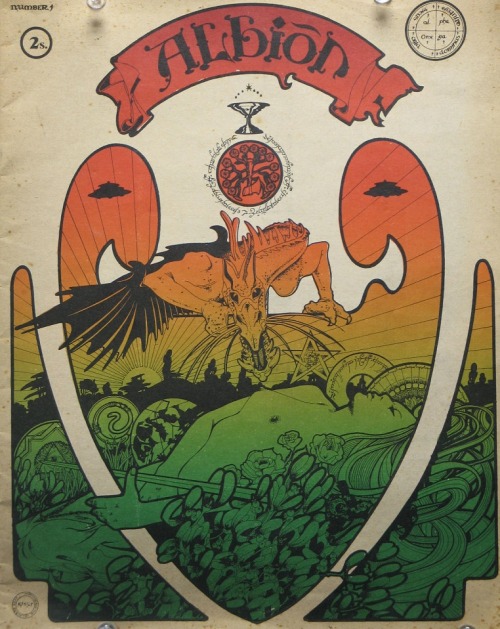
Artwork for Albion magazine, 1968


Poster for Granny Takes A Trip boutique, 1967


 Welcome Cosmic Visions, poster by Hapshash and the Coloured Coat from 1968


Posters designed by English and Weymouth for OZ magazine, 1968

Michael English: After Hapshash and the Coloured Coat produced a record (featuring The Heavy Metal Kids) on not a black but a red semi-transparent disc, Nigel remained infatuated with music at the expense of graphics, and the Hapshash partnership died (English, p 12).


Hapshash and The Coloured Coat featuring The Human Lost and The Heavy Metal Kids. Album cover, 1968


Michael English photographed by David Bailey in 1978.

All the images and quotations taken from "3D Eye" by Michael English (1979)


(I love finding people's names in second hand books. There's something thrilling in the fact that somebody was flicking through the same pages years before I was even born...)

Tuesday, 15 January 2013

Bouton Rouge Sessions


The Yardbirds playing Bouton Rouge, early 1968

Bouton Rouge was a French live-music TV show which ran between 1967 and 1968. During its short existence, it captured some of the best British Mod/Psych bands at their peak. A lot of Bouton Rouge footage had emerged on YouTube recently, and I must say it is a feast for both, eyes and ears. We can see performances by Jimmy Page-era Yardbirds, The Blossom Toes, The Small Faces with P.P. Arnold, The Moody Blues and many more. Here I enclose some of the more interesting ones...


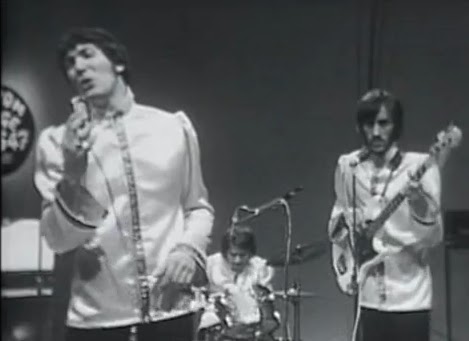
Timebox playing Bouton Rouge, 09.03.1968


Timebox were a soul/psych band from Southport, Lancashire.Here they are performing their version of 'Beggin' (originally by The Four Seasons), 'Hold No Grudge' and 'Come On Up'. I love what they are wearing. It is a design  inspired by 19th Century Russian peasant shirt. It might be from Mr. Fish or John Stephen, although it is hard to say, as by 1968, Carnaby Street was full of stuff like that.


Intresting piece of trivia about Timebox: Ollie Halsall, who plays vibraphone, and drummer John Halsey 'went on to bigger things' as members of The Rutles - Eric Idle's brilliant spoof of The Beatles, and second most famous (after Spinal Tap) joke band ever. Halsey played the drums on all Rutles songs and he appeared in All You Need Is Cash (1978) as drummer Barry Wom, based on Ringo. Halsall,sang all the McCartney-esque  songs, but since Eric Idle played the part of Dirk McQuickly (McCartney) in the film, Halsall only made very brief appearance as original  bassist Leppo (based on Stuart Sutcliffe).


This one must be my favorite: Psych-era The Yardbirds with Jimmy Page on guitar. Here they are doing three songs: classic 'Train Kept-A-Rollin', even more classic 'Dazed and Confused' and their pop-psych hit 'Goodnight Sweet Josephine'. The most interesting is 'Dazed and Confused' which Page will perfect with Led Zeppelin. Of course, Led Zep's version was better, which doesn't mean that this one is bad. Keith Relf delivery is not as powerful as Robert Plant's, but arguably, his lyrics are more interesting.. .In  any case, this footage is twelve minutes of pure perfection.


Another interesting one is  a performance of Grapefruit.


Grapefruit were signed to Beatles' label Apple, but unlike their label-mates (and fellow Beatles soundalikes) Badfinger, they never really got much recognition. Here they are doing two numbers: 'Yes'  - a piece of Merseybeat pop which must have sounded strangely anachronistic in 1968, and 'Dear Delilah', again heavily inspired by Beatles, but this time from Sgt. Pepper era.


(recorded on 16.03.1968)


This is rare: Pink Floyd performing Syd's songs without Syd. This was recorded on 22.02.1968 - literally within days of Syd's departure from Pink Floyd. Dave Gilmour takes over vocals on 'Astronomy Domine' and 'Flaming'. It still sounds great, but the band are visibly uncomfortable. Roger Waters' dark psychedelic gem 'Set The Controls For the Heart Of The Sun' sounds amazing, and 'Let there Be Light' is an indication of Pink Floyd's new , post-Syd direction (unfortunately, for some reason it won't let me put it up here). Brilliant footage.


London Psychedelic scene heroes Blossom Toes are performing 'Listen To The Silence', 'Mister Watchmaker' and 'The Remarkable Saga Of Frozen Dog' (recorded on 23.03.1968).


Blossom Toes, 1968


I'll end with with this magnificent performance of Small Faces' 'Itchycoo Park' and 'If You Think You're Groovy' with P.P.Arnold.


There is more: Ten Years After, Moody Blues, Procol Harum  and few other. All of them worth checking out.

Thursday, 15 December 2011

Syd Barrett - 1960's Peacock Style Icon

Syd Barrett, September 1967

What can be said about Syd Barrett that hadn't been said already? His brief musical career as a lead singer/guitarist of Pink Floyd and solo artist, followed by acid-induced madness and withdrawal from the world still continues to fascinate and, over the years, he has been a subject of numerous books, articles and documentaries.

Syd in January 1967.

Syd with early girlfriend Lindsay Corner, 1967

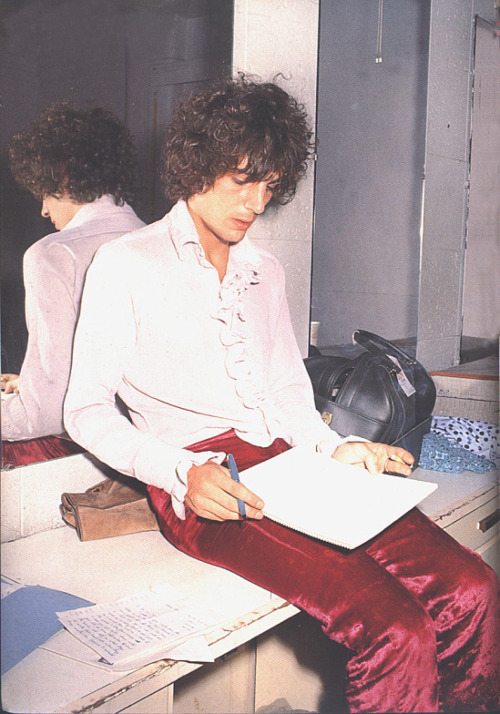
As well as being an influential guitarist and songwriter, Barrett also deserves a credit as a style icon. In the spirit of the times, his look was very flamboyant - Paisley shirts, frilled shirts, satin or velvet trousers, double breasted jackets, cravats etc. Like many other London musicians at the time , Barrett was buying his psychedelic/peacock gear in King's Road boutiques.Some of his clothes were made to measure by designer Thea Porter. Julian Palacios wrote in his biography of Barrett: For Syd, the image tied in with his art, rather than simple vanity. The era demanded peacocks. Barrett stepped up and took on the role of a star (Julian Palacios, Dark Globe : Syd Barrett and Pink Floyd, p 205).

Pink Floyd, 1967


Pink Floyd, 1967


Pink Floyd, 1967

 Syd in 1967

Barrett had a rare ability of pulling off nearly any outfit. It is visible in the photos of Pink Floyd circa 1967. Your eye is instantly drawn to Barrett, while his band mates look rather uncomfortable, or even ridiculous (just look at Roger Waters) in their psychedelic gear.

Pink Floyd, 1967:  Nick Mason, Rick Wright, Roger Waters and Syd Barrett

Syd Barrett, 1967

1967

Syd and Roger Waters, 1967

Nick Mason, Syd Barrett and Rick Wright in De Lane Lea studio, October 1967

Pink Floyd performing at Top Of The Pops, 1967

Syd In July 1967

Syd in July 1967

Pink Floyd on tour in Denmark, 11.09.1967. Syd Barrett, Roger Waters, Nick Mason and Rick 
Wright.

Syd with Roger Waters, 1967

Roger Waters and Syd Barrett, 1967

Syd Barrett, Rick Wright and Roger Waters, 1967


Where's Syd? - Pink Floyd on a package tour with Jimi Hendrix Experience, The Move and Amen Corner, November 1967.

Syd on tour, 1967

Syd's girlfriend, Lindsay Corner was his sartorial advisor. Julian Palacios wrote: As his star rose, Lindsay's sharp eye and expert combination of King's Road cool were crucial to his new look. Her keen eye made for inspired choices. With hair grown out his trendy Carnaby Street trousers and candy striped shirts sacrificed for velvet, satin, silk in red, lilac and green, and crimson. Syd and Lindsay took to the King's Road fashion scene with relish, migrating to Granny Takes a Trip, where Barrett was fitted for a satin outfit in green and red. Next was Gohil's leather Goods store in Camden, where the owner outlined Syd's feet for custom-made short ankle boots with elastic gussets.
With Lindsay, Barrett made the scene dressed in silk and velvet, in pied patches like medieval minstrels. Walking on King's Road on Saturdays, dressed in all their finery, the couple were splendid peacocks on parade. In a luminous dash, they prowled boutiques, piecing a unisex wardrobe mix of gypsy, aristocrat, harlequin and harlot (Julian Palacios, Dark Globe : Syd Barrett and Pink Floyd, p 205).
Following  Lindsay Corner's advice, Syd also started using kohl eyeliner, which, combined with his black, messy hair made him a precursor of Gothic look. There is indeed a very Gothic feel to certain photographs of Syd Barrett and Pink Floyd.


Pink Floyd, 1967 (or is it The Cure in 1981?)


Pink Floyd , 1967


Pink Floyd , 1967


Pink Floyd , 1967


Syd Barrett with a friend Jenny Spires in July 1967.

 1967

Syd Barrett's uncontrollable LSD intake was a cause of his increasingly erratic behavior which was a reason for his departure from Pink Floyd in early 1968. Despite his problems, he managed to record two great solo albums: "The Madcap Laughs" (1969) and "Barrett"(1971) - both produced by Dave Gilmour - Barrett's friend and his replacement in Pink Floyd.


Syd in 1969, during recording of "The Madcup Laughs".


1969


Syd Barrett photographed by Mick Rock, London 1969.  


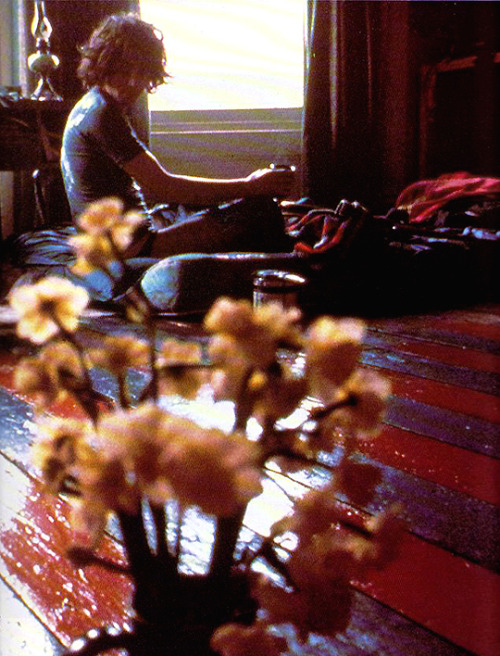
Syd Barrett posing for the photoshoot for a cover of "The Madcap Laughs". This photo was taken in Syd's flat in South Kensington by Mick Rock in 1969.


1969

Syd in 1971

After a last, unsuccessful visit to studio in 1974, Syd Barrett had vanished from public eye for good. He never came back to playing music, and from seventies onwards, he led a life of a recluse. He became one of the most enigmatic figures in popular music history. The interest in Barrett had increased after his death in July 2006. In 2010, two very extensive biographies of Barrett were published within two months of each other: Dark Globe : Syd Barrett and Pink Floyd by Julian Palacios and Very Irregular Head by Rob Chapman.


Although there are similarities between the two publications ( In both books, for example, chapters start with quotations from The Wind In The Willows by Kenneth Grahame - one of the biggest lyrical influences on Syd) they are surprisingly different. Rob Chapman makes rather unconvincing attempt to portray Barrett as a modern-day English Romantic. He spends a lot of time doing pseudo-academic analysis of Syd's lyrics, and devotes a lot of  too much space to his literary influences. There is surprisingly little about his musical influences  - his teenage love of blues and R'n'B hardly gets mentioned, neither does the fact that he abandoned blues in order to venture into more experimental fields. Chapman fails to remember that Barrett was, above all, a rocker. His innovative ways of playing guitar were more influential than his work as lyricist.As Julian Palancios notices in his, much better book, Barrett was one of the few iconic 60's musicians whose work was embraced  post-punk musicians of late 70's. For that generation of musicians who sought to play a guitar music that is not based on blues, Syd's work was a big influence. Public Image Ltd, Echo and The Bunnymen, Jesus and Mary Chain, Siouxsie and The Banshees, The Cure (Robert Smith's look seemed to be also partly inspired by Barrett) - all of those acts spoke of their love of Syd Barret and early Pink Floyd (while the 1970's incarnation of Pink Floyd represented everything they stood against).
In Dark Globe : Syd Barrett and Pink Floyd Julian Palacios also makes a very interesting account of London underground psychedelic scene between 1966 and 1967 - a parallel story which is almost as fascinating as the story of Syd. I throughly recommend Julian Palacios's book as the best one ever written on the subject of Syd Barrett.