Perhaps it's because of Easter - a family holiday - but I feel it
may be the right time to do a post devoted to a country in which I was born - Poland.
Or maybe I'm getting temporarily bored with the stuff I usually write about.
Either way, I think a little change may be refreshing.
Anyway, in the last year or so, thanks to the miracle of
Internet, I have discovered - much to my surprise - that Poland
actually had a pretty vibrant Rock n' roll/Beat/Garage/Psych scene, especially
from 1965 onwards (not that I've ever heard of any of those bands when I actually lived in Poland). In the recent issue of Shindig! magazine, there was a great article on the subject, although I did not entirely agree with the choice of bands covered. So here I gonna do it my own way. Of course, I have advantage in the fact that I can actuallyl understand Polish language (I am not so confident about speaking, though. I haven't had conversation in Polish for several years) which allows me the full appreciation of this stuff. But, to those who are regular readers of this blog, I can guarantee that once you get past unpronounceable band names and strangely sounding lyrics, there is a great music there to be enjoyed. So let me take a break from my usual ramblings about Swinging Sixties London, to see what the sixties were like on the wrong side of the iron curtain.
For the young music fans in 1960's Poland, the biggest problem was a limited availability of Western records. Although The Beatles, Stones, etc. were as popular in Poland as anywhere else in Europe, their records were not being sold in record shops. The singles were largely available on so-called 'music-postards' (a sort of floppy rectangular picture disc), but it took a lot of effort to find albums. Usually black market was your best bet. It also helped if you, or somebody you knew had family or friends abroad.
Live performances of Western artists were also limited. I am not sure whether it was a case of needing a permission from authorities, or a case of bands not being that bothered about playing Poland, or a little bit of both. The fact is, some of the big English bands of the 1960's did make it to Poland - In 1965 and 1966 The Hollies, The Animals and even London Mod/Psych heroes The Artwoods all successfully toured there.

Article (NME? Melody Maker?) about The Artwoods' communication problems in Poland, 1966 (via Punks In Parkas)
Then, in 1967, a miracle happened. On 13th of April The Rolling Stones came to play one-off gig in Warsaw. It was their only ever gig behind iron curtain (although they did returned to Poland twice after the curtain fell down). In Poland, this gig has a legend of its own. Anybody who lived in Warsaw at the time and was age between 12 - 30, claims to have been at that gig. Unfortunately, the capacity of the venue was only about 3000, so a lot of people did not manage to get a ticket. They showed up on the night anyway, just to be in the proximity of their idols, and caused a riot outside Warsaw's Kongresowa Hall.
A brief footage of that gig from Polish news report. The newsreader says something like: Thousands of fans gathered outside Kongresowa Hall to see band The Rolling Stones. There wasn't enough tickets for everybody. Those lucky enough to get a ticket couldn't hear anything anyway. But it doesn't matter, because this a kind of gig you experience, rather than listen to.
To a Polish audience The Stones - at the time in the middle of their psychedelic phase - seemed exotic, to say the least. The Stones themselves also experienced a little bit of cultural shock. This is how Bill Wyman remembers that gig: Warsaw was depressingly gray and dismal. On our drive to the best hotel in town, we noticed that the streets seemed strangely quiet with very little traffic and pedestrians.After checking in, I found my room to be triangular with a huge circular concrete pillar in the centre of the room.(...) Everybody was in and out of each other's rooms to see who had the best one - none of them were very good.(...) There were large crowds of kids in front of our hotel as we left, held back by the police. They were chanting: Long Live The Stones! (...) Once inside (the concert venue), we found that the tickets for our show had not been put on sale. They were given to loyal party members. This meant all the real fans were outside, unable to get tickets, but the audience seemed to get into it as we went along. Towards the end of our set they began chanting 'Icantgetno, Icantgetno'. It took a while for us to realise that they wanted 'Satisfaction'. (Bill Wyman, Rolling With The Stones, Dorling Kindersley, 2002, p 270).
Bill Wyman was wrong, though. Although some tickets were indeed given to party members, they were definitely put on general sale as well. They were expensive and got snapped up quickly, but quite a few 'true fans' did get to see The Stones (and the footage above seems to confirm it).
Interesting thing about that gig was that during the soundcheck, it turned out that Stones' instruments couldn't be connected to Polish electricity (something to do with a different voltage, apparently) So during the concert The Rolling Stones were using guitars and amps which belonged to a support act - a Polish beat group called Niebiesko-Czarni.
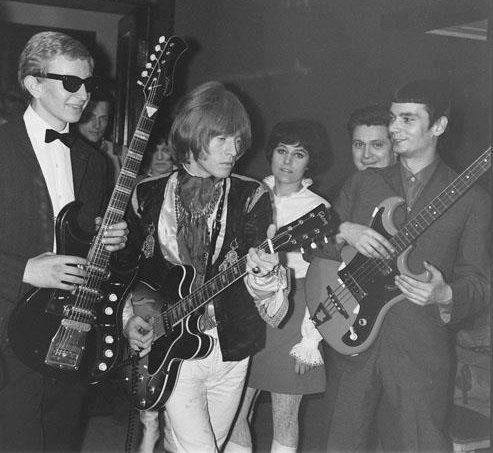
Brian Jones and members of Niebiesko-Czarni, 13.04.1967
Niebiesko-Czarni (The Black n' Blue's) were one of the first and most important Polish groups of the 1960's. They formed in 1962 around guitarist/lead singer Wojtek Korda and initially they played various forms of Twist and Rock n' Roll. In the mid-1960's they were joined by a femle lead singer Ada Rusowicz, and their career really took off.

Niebiesko-Czarni performing on Polish TV in 1966
Onstage, Niebiesko-Czarni wore blue turtlenecks and black trousers - hence their name. They had a string of successful singles, and they recorded two albums between 1965 and 1967. Then, just like the groups in Western Europe, Niebiesko-Czarni 'went psychedelic'. Blue turtlenecks were replaced by beads and kaftans.

Niebiesko-Czarni, 1968

Ada Rusowicz

Cover of the album Twarze ('The Faces') by Niebiesko-Czarni, 1968.
Their sound, as well as their look became more interesting. They recorded two psychedelic-tinged albums - Twarze in 1968 and Mamy Dla Was Kwiaty ('We've Got Flowers For You' - with a great cover which you can see at the top of the post) in 1969.I haven't heard any of the those albums in their entirety, but if the title track of the second one is anything to go by, it must be pretty good. Very influenced by what was going on in England at the time, especially S.F. Sorrow by The Pretty Things.
The revolving-door line-up changes of Niebiesko-Czarni made them almost 'a school for future pop stars'. Quite a few ex-members of this band became went on to bigger things. One of them was guitarist/lead singer Krzysztof Klenczon who quit in 1965 and took over vocals in a band called Czerwone Gitary ('The Red Guitars' - and no, it was not a reference to a political situation of Poland). If there is any band that deserves a title of 'Polish Beatles', it's Czerwone Gitary. And it's not just a scale of their popularity. Musically they were very, very heavily influenced by the Fab Four. But even if they were copyists, they were good copyists.Some Poles like to claim that if The Red Guitars lived in England and sang the same songs in English, they would have been as big as The Beatles. That's a bit of a stretch - they weren't that good - but they certainly would have given The Hollies or The Zombies a run for their money.
Here's Czerwone Gitary doing one of their biggest hits - 'Nie Zadzieraj Nosa' (a Polish idiom meaning as much as 'don't be so stuck-up') - a song from 1968 with a very triumphant chorus in the style of 'She Loves You' or 'Twist and Shout'. They were clearly very uncomfortable having to mime to their song on the TV , which shows through their exaggerated dance movements...
Here's another one - a nice ballad titled 'Historia Jednej Znajomosci' ('A Story of a Brief Aquintanship'). There is something about that song that really catches both, teenage blues and gray Polish reality.
That's just two of their many successful singles. In the 1960's every country tried to produce 'their own Beatles'. Czerwone Gitary were one of the few European bands that for a brief period almost managed to match the efforts of the Fab Four. They remained popular throughout the 1970's although their leader Krzysztof Klenczon left in 1972. He moved to USA, where sadly, he died in a car accident in early 1980's.
Now, on to my favorite part - Freakbeat and Garage. I'll start with a band called Chocholy ('The Hollows') doing an aggressive Rhythm n' Blues number titled 'Amor A Kysz' (Stay Away, Cupid!) which wouldn't sound out of place in London's Marquee club. (song from 1965)
Chocholy were a popular R n'B group. When their lead singer Wojciech Gassowski quit in 1967, they changed name to Akwarele ('The Watercolours') and became a backing band for a popular Prog-rocker Czeslaw Niemen (a former member of Niebiesko-Czarni).
Here's another great track - Stale To Samo ('Always The Same') by appropriately named Dzikusy (The Wild-Ones). Their Farfisa-led Freakbeat wasn't million miles away from what teenagers across America were doing around the same time (1966).I couldn't paste it in here, so just click on the link.
Another great Polish band from that time that crossed into Freakbeat territory were Polanie ('The Polans' - named after medieval tribe - the fore-fathers of Poles). They were heavily inspired by aggresive, organ-led R n' B of The Animals. One of their best tracks was 'Nie Zawroce' (I Won't Turn Back') which combined R n'B with heavy soul.
Polanie covered a lot of British Mod/Psych songs like 'Cool Jerk' by The Creation or 'Can You Hear Me?' by The Artwoods. Here's their absolutely insane version of Animals' 'I'm Crying'.
When The Animals toured Poland in 1966, Polanie were a support act. Reportedly, Eric Burdon was very impressed with the energy of their live performances, and he invited Polanie To Britain to tour with The Animals. These plans came to nothing when Polanie couldn't get UK visas. Still, they were one of the few Polish bands which toured Western Europe - France and West Germany (where they supported The Animals again).
In the last few years some few compilations of Polish Beat/Garage/Psyche were released in Britain - two volumes of Wrenchin' The Wires and Working Class Devils (rubbish title, if you ask me..). They contain some great gems from the Polish 60's beat scene.


More details at Paradise Of Garage Comps
Now I am gonna move into late-60's Hippie territory. In Poland, the undisputed leaders in that field was a band called Breakout.The band was led by Tadeusz Nalepa, who was thought to be the greatest blues/rock guitarist in Poland. They started in a mid-1960's as a beat combo called Blackout, changing their name to Breakout after they were joined by a female lead singer Mira Kubasinska. Their music was a mix of heavy blues and psyche with progressive undertones and pop sensibility. Think Hendrix jamming with Jefferson Airplane or a much heavier version of Shocking Blue..
Here's Breakout doing their 1969 hit 'Poszlabym Za Toba' (I Would Follow You)
Another good song by Breakout was called 'Gdybys Kochal, Hej!' ('If You Only Loved Me, Hey!'). I don't know whether Tadeusz Nalepa and Mira Kubasinska were a couple, but in this video they they seem like they have a Sonny Bono/Cher thing going on. Bassist clearly has a lot of fun hiding behind the tree. The main riff clearly owes a lot to Hendrix's version of 'Hey Joe'.
Breakout continued to record great music after the departure of Mira Kubasinska in 1971. That year, they released an album, unimaginatively titled Blues. It is a great heavy blues-rock album full of fiery guitar solos complemented by Hammond organ and soulful vocals of Tadeusz Nalepa. One of the best songs on the album was called 'Pomaluj Moje Sny' ('Paint My Dreams').
Since I crossed into early 1970's, I want to mention two other important Polish bands from that period. First one is a progressive rock band called Klan. Their 1971 album 'Mrowisko' ('The Hive') is a mix of psychedelic heavy rock and jazz. It resembles early stuff of The Soft Machine or Colosseum, but it's much less self-indulgent. I'm not sure wheter the band got much recognition for it, as they seem to be pretty obscure even in Poland, which is a shame, because 'Mrowisko' is one of the best Polish records of the time.

Cover of 'Mrowisko' by Klan, 1971 (listen to the album here)
Another Polish band from that time worth mentioning was Nurt ('The Stream'). Their only album, released in 1972, was also a mix of Heavy Psyche, Prog and Jazz, but with a lot of emphasis on 'Heavy'. I was pretty blown away by virtuoso musicianship of Nurt (especially their guitarist). Unlike a lot of Prog albums from early 1970's, this one avoids a trap of being overly self-indulgent or boring.
This is a song called 'Pisze Kreda Po Asfalcie' ('I Write On Asphalth With a Chalk') from Nurt's self-titled 1972 album..
I'll end with something from the mid-Sixties..


This charming lady is a pop singer Helena Majdaniec. She was sort of a Polish Cilla Black or Sandie Shaw. After having a string of incredibly twee pop hits in Poland, she emigrated to France, where she continued her musical career, apparently achieving considerable popularity in continental Europe. Here's a footage of her performing a song in English on German TV in 1966. The audio is pretty bad and the song is not particularly good, but she and her French backing band, as well as he audience look absolutely amazing..
Make no mistake, the life in Socialist Poland in the 1960's was far from perfect. But that didn't stop the youth of that country from producing their own interesting music or, as I intend to show in part two of my 'Polish Special' , films and fashion icons.